
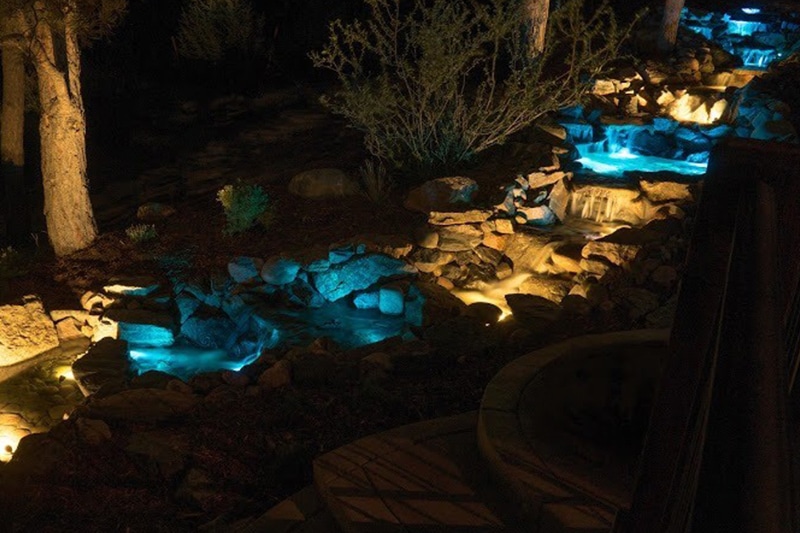
There’s something almost magical about a beautifully lit water feature after dark. The way light plays off moving water, the reflections dancing across the surface of a koi pond, the gentle glow illuminating a cascading waterfall, it transforms your Denver backyard into something truly special.
At Art of the Yard, we’ve spent over 30 years designing and installing custom water features throughout the metro Denver area. And here’s what we’ve learned: a stunning pond or fountain that looks incredible during the day can completely disappear once the sun sets. That’s a missed opportunity. With the right landscape lighting ideas for water features, you can extend your enjoyment well into the evening hours and create an outdoor space that captivates both day and night.
Whether you’ve got an existing koi pond that needs a lighting refresh or you’re planning a brand-new contemporary water feature, this guide will walk you through everything you need to know, from the best techniques and fixture choices to placement strategies that maximize visual impact in Colorado’s unique climate.
Why Water Feature Lighting Matters in Colorado Landscapes
Let’s be honest, you invested significant time, money, and thought into your water feature. Maybe it’s a natural rock waterfall that echoes the stunning landscapes you’ve hiked through in the Rockies. Or perhaps it’s a sleek, contemporary fountain with geometric lines and polished metal accents. Either way, that investment shouldn’t clock out at sunset.
Proper lighting does more than just make your water feature visible at night. It fundamentally changes the experience of your outdoor space. Here in Colorado, we’re blessed with roughly 300 days of sunshine per year, but that also means plenty of crisp, clear evenings perfect for enjoying your backyard. Without lighting, your beautiful pond or fountain becomes a dark void, or worse, a potential safety hazard.
From a practical standpoint, illuminated water features help define pathways and prevent guests from accidentally stepping somewhere they shouldn’t. But the real magic is aesthetic. Light interacts with water in ways it simply can’t with static landscape elements. It catches the movement of a fountain’s spray, reveals the depth and life in a koi pond, and creates mesmerizing shadow patterns from waterfalls.
We’ve also noticed that well-lit water features become the natural gathering spot in any yard. There’s something inherently calming about the combination of water sounds and soft illumination that draws people in. It’s why restaurants and hotels invest so heavily in these features, and why your Denver home deserves the same attention to detail.
Beyond enjoyment, there’s the matter of home value. A professionally designed lighting system for your water feature signals quality craftsmanship and thoughtful landscape design. It’s the kind of detail that makes potential buyers, or just envious neighbors, take notice.
Best Lighting Techniques for Ponds and Fountains
Not all water feature lighting is created equal. The technique you choose dramatically affects the mood, visibility, and overall impact of your installation. Let’s break down the approaches that work best for ponds and fountains in the Denver area.
Submersible Lights for Underwater Effects
Submersible lights are exactly what they sound like, fixtures designed to operate completely underwater. They’re the secret weapon for creating that ethereal, glowing-from-within effect that makes koi ponds and fountain basins look absolutely stunning.
When we install submersible lights in a pond, we typically position them to illuminate from below the water’s surface upward. This creates a completely different visual than surface lighting. The water itself becomes luminous, revealing the movement of fish, the texture of natural rock formations, and the depth of the feature.
For koi ponds specifically, submersible lights let you actually see your fish after dark. Positioned correctly, they’ll illuminate the koi without creating harsh glare on the water‘s surface. Many of our clients tell us this is when they most enjoy their pond, watching their koi glide through softly lit water on a quiet evening.
In fountains, underwater lights can be aimed to catch the spray as water emerges, creating that signature sparkle effect. The key is using fixtures rated for continuous submersion, not just splash resistance. We’ve seen too many DIY installations fail because homeowners used the wrong IP rating for their fixtures.
Spotlights and Uplighting for Movement and Drama
While submersible lights handle the underwater work, spotlights and uplighting address everything above the surface. These techniques are essential for waterfalls, streams, and the structural elements of contemporary water features.
Uplighting involves positioning fixtures at ground level, angled upward toward the feature. For a natural rock waterfall, this creates dramatic shadows and highlights the texture of the stone. The effect is almost theatrical, think of how stage lighting transforms a performance.
Spotlights give you more focused, directional control. We often use them to highlight the point where water cascades over rocks or emerges from a scupper in a modern installation. The moving water catches the light beautifully, creating constant visual interest.
One technique we particularly love for Denver properties is cross-lighting, using multiple spotlights from different angles. This eliminates harsh shadows and creates a more natural, three-dimensional appearance. It’s especially effective for larger water features where a single light source would leave portions in darkness.
The combination of underwater and above-water lighting creates layers of illumination that make your water feature look professionally designed, because it is.
Choosing Fixtures That Withstand Denver’s Climate
Denver’s climate is beautiful but demanding. We experience temperature swings of 40 degrees or more in a single day, intense UV exposure at altitude, occasional hailstorms, and winters that can drop well below zero. Your water feature lighting needs to handle all of it.
The first consideration is temperature tolerance. Fixtures rated for moderate climates may crack or fail when exposed to Denver’s freeze-thaw cycles. We recommend fixtures specifically rated for temperature extremes, look for operating ranges that extend to at least -20°F on the low end.
For submersible fixtures, the IP (Ingress Protection) rating matters enormously. You want IP68 at minimum for anything going underwater permanently. IP67 might technically work, but it’s rated for temporary immersion only. Why risk a failure in the middle of your water feature?
Material quality separates fixtures that last a decade from those that corrode within a year or two. At altitude, UV degradation happens faster than at sea level. Cheap plastic housings become brittle and discolored. We specify fixtures with marine-grade stainless steel, brass, or composite housings designed for outdoor use.
Corrosion is another concern, especially in water features with any mineral content or treatment chemicals. Brass fixtures with quality seals tend to outlast alternatives in our experience. They cost more upfront but save headaches, and replacement costs, down the road.
Cable and connection quality often gets overlooked. All outdoor electrical connections should use waterproof junction boxes and properly rated connectors. We’ve seen gorgeous lighting installations fail not because of the fixtures themselves, but because of cheap connections that let moisture in.
One more Denver-specific consideration: hail. Lens materials matter. Tempered glass holds up far better than polycarbonate when a surprise storm rolls through in June. Given how many vehicles get totaled by hail around here, protecting your investment with quality materials just makes sense.
Color Temperature and Ambiance Considerations
Color temperature might sound technical, but it’s actually one of the most important aesthetic decisions you’ll make. It determines whether your water feature feels warm and inviting or cool and contemporary, and the wrong choice can undermine an otherwise perfect installation.
Color temperature is measured in Kelvin (K). Lower numbers (2700K-3000K) produce warm, amber-toned light similar to candlelight or incandescent bulbs. Higher numbers (4000K-5000K) create cooler, bluer light that mimics daylight.
For natural-style water features, think rock waterfalls, streams, and koi ponds with native plantings, warm white light in the 2700K-3000K range typically works best. It complements the earthy tones of natural stone, makes greenery look lush rather than washed out, and creates that inviting, relaxing atmosphere most homeowners want.
Contemporary water features often call for cooler temperatures. That sleek concrete fountain with polished metal accents? It might look stunning with 4000K lighting that emphasizes its modern lines. Some of our clients with ultra-modern designs even go cooler, though we generally recommend staying under 5000K to avoid that harsh, institutional feel.
Here’s where it gets interesting: you don’t have to choose just one. Many current LED systems offer adjustable color temperature, letting you shift between warm and cool depending on the occasion. Hosting a dinner party? Go warm. Showcasing your contemporary design aesthetic? Shift cooler.
Some homeowners are tempted by color-changing RGB lights that cycle through blues, reds, greens, and everything in between. We’ll install them if that’s what you want, but our honest advice? Use them sparingly. A subtle blue undertone can enhance the appearance of water, but rainbow cycling effects tend to look more like a theme park than an elegant landscape. Static white light, whatever temperature you choose, almost always photographs better and ages more gracefully as a design choice.
Consistency matters too. If you’re lighting multiple elements, a pond, a waterfall, pathway lights, keeping the same color temperature throughout creates visual cohesion. Mixed temperatures look unintentional and fragmented.
Energy-Efficient Options for Outdoor Water Features
Running lights several hours every evening adds up. Energy efficiency isn’t just about being environmentally responsible, though that matters, it’s about keeping your electricity bills reasonable and your lighting system sustainable long-term.
LED technology has completely transformed outdoor lighting. Compared to halogen fixtures that were standard just fifteen years ago, modern LEDs use roughly 75% less energy while lasting significantly longer. For water feature lighting specifically, that efficiency advantage is huge because these fixtures often run for extended periods.
Beyond basic LED fixtures, we’re seeing exciting developments in smart controls. Timers are the baseline, set your lights to turn on at dusk and off at a reasonable hour, and you eliminate both wasted energy and the hassle of manual switching. But current systems go further with photocells that respond to actual light levels, motion sensors for accent lighting, and smartphone integration that lets you control everything from your couch.
Solar-powered options have improved dramatically and can work for certain applications. Small accent lights along a pond’s edge or pathway lighting near your water feature can run entirely off solar. But, we’re still cautious about recommending solar for primary water feature illumination in Denver. Our winters have shorter days and the sun angle reduces charging efficiency. Primary fixtures are usually better served by hardwired LED systems.
Low-voltage systems (12V or 24V) offer another efficiency advantage. They’re safer for underwater applications, allow for longer wire runs without significant voltage drop, and the transformers that power them are more efficient than ever. Plus, low-voltage installation is often simpler and less expensive than line-voltage alternatives.
One often-overlooked efficiency consideration: proper fixture selection means you need fewer lights to achieve the same effect. A quality spotlight with good optics and output might replace two or three cheap fixtures, reducing both energy consumption and maintenance burden.
At Art of the Yard, we factor energy efficiency into every lighting design. It’s not just about the fixtures, it’s about creating a system that delivers beautiful results without unnecessary waste.
Placement Tips for Maximum Visual Impact
You can have the best fixtures money can buy, but poor placement will ruin the effect. Strategic positioning separates amateur installations from professional results. Here’s what we’ve learned through decades of designing water feature lighting across metro Denver.
First, think about viewing angles. Where will people actually be when they’re looking at your water feature? The patio? Through a window from inside? Walking along a path? Your lighting should optimize the view from these primary perspectives. A light that looks great from one angle might create blinding glare from another.
For ponds, we generally position submersible lights away from the main viewing area, aimed back toward where people will be standing or sitting. This illuminates the water and any fish without creating that harsh reflection that makes you squint.
Waterfalls benefit from lighting positioned to the sides rather than directly in front. Side lighting catches the texture of the water as it cascades, revealing every ripple and splash. Front lighting tends to flatten the effect and can create glare off the wet rock surfaces.
Depth layering creates professional-looking results. Rather than lighting everything evenly, create zones of light and shadow. Bright focal points draw the eye, while softer ambient lighting provides context. Your water feature should be the star, with surrounding plantings and hardscaping playing supporting roles.
Don’t forget about what’s behind your water feature. A beautifully lit pond in front of a dark void looks odd. Consider adding subtle uplighting on trees or architectural elements in the background to create visual depth and context.
Concealment matters too. Visible fixtures break the illusion. We hide lights behind rocks, within plantings, or in purpose-built recesses whenever possible. The goal is for guests to notice the beautiful lighting effect, not the hardware creating it.
Finally, avoid overlighting. More fixtures doesn’t mean better results. A few well-placed lights typically outperform a dozen poorly positioned ones. When in doubt, start with less and add more only if needed. You can always add another fixture, but an overlighted water feature loses all its subtlety and drama.
Conclusion
The right landscape lighting transforms your water feature from a daytime attraction into an all-hours centerpiece. It extends your enjoyment, enhances safety, and adds genuine value to your Denver property.
Getting it right requires attention to multiple factors, technique selection, fixture durability for Colorado’s demanding climate, appropriate color temperature, energy efficiency, and strategic placement. Each element builds on the others. Skip one, and the whole installation suffers.
At Art of the Yard, we approach water feature lighting the same way we approach everything else: with careful planning, quality materials, and the expertise that comes from over 30 years of experience in metro Denver landscapes. Whether you’re adding lighting to an existing koi pond or planning a complete custom water feature from scratch, we’ll help you create something that looks stunning around the clock.
Ready to see your water feature in a whole new light? Contact us for a free consultation. We’ll walk through your space, discuss your vision, and explain exactly how we can bring it to life. No project is too big or too small for our team, and we guarantee our workmanship for a full year.
Let us turn your backyard into a masterpiece, day and night.
