
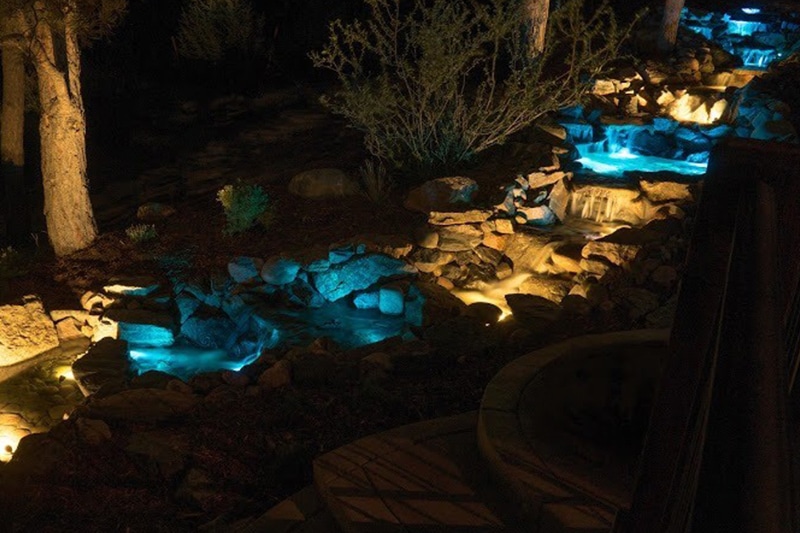
Contemporary landscape design thrives on precision. The clean geometry of modern water features, the sharp angles of architectural planters, the deliberate restraint of a monochromatic palette, all of it demands lighting that understands the assignment. We’re not talking about flooding your yard with generic illumination. We’re talking about using light as a design tool, one that emphasizes lines, creates dramatic washes, and yes, strategically deploys shadows. At Art of the Yard, we’ve spent years perfecting how lighting interacts with contemporary water features and hardscapes throughout metro Denver. Let’s break down how you can bring that same intentionality to your outdoor space.
Why Contemporary Landscape Lighting Prioritizes Geometry Over Glow
Traditional landscape lighting often aims for warmth and ambiance, soft pools of light around a flower bed, maybe a lantern by the front door. Contemporary lighting flips that approach. Instead of diffuse glow, we emphasize geometry. The goal is to reinforce the architectural lines already present in your space.
Think about a sleek concrete wall with a single scupper, water cascading into a steel basin below. That’s not a feature that benefits from soft, romantic lighting. It needs crisp illumination that highlights the linear flow of water and the industrial materials. The light itself becomes part of the design language.
This is why we often start lighting conversations by looking at the hardscape first. Where are the edges? What angles are we working with? Contemporary yards tend to feature repeating patterns, straight lines, and deliberate negative space. Your lighting should echo those choices rather than fight against them. When geometry leads, the entire composition feels cohesive, and that’s what separates a well-lit yard from a merely illuminated one.
Creating Clean Lines With Linear Light Fixtures
Linear fixtures are the workhorses of contemporary outdoor lighting. These elongated lights, whether recessed into steps, mounted beneath ledges, or integrated into planters, create unbroken lines of illumination that mirror the architecture around them.
We frequently use LED strip lighting tucked into channels along pathways or beneath the lip of raised water features. The effect is subtle but powerful: a glowing edge that defines the space without competing with it. For a contemporary fountain built from polished metal or sleek stone, a linear fixture running beneath the basin can make the entire structure appear to float.
Placement matters enormously here. A linear light positioned too high loses its impact. Too low, and you’re creating glare instead of ambiance. We typically recommend installing these fixtures where they’ll graze surfaces, catching the texture of concrete, emphasizing the polish of steel, or drawing the eye along a clean horizontal plane.
The key is restraint. One well-placed linear fixture does more work than five poorly positioned spotlights. And because contemporary design already celebrates simplicity, your lighting should follow suit.
Using Wall Washes to Add Depth and Drama
Wall washing is exactly what it sounds like: bathing a vertical surface in even, consistent light. In contemporary yards, this technique transforms flat walls into focal points.
Picture a textured concrete feature wall, maybe the backdrop to your water garden or the boundary of your outdoor seating area. Without lighting, it’s just a wall. With a proper wall wash, the texture comes alive. Every subtle variation in the surface catches light differently, creating visual interest that wasn’t apparent during the day.
We position wall wash fixtures at the base of the wall, angled upward at roughly 30 degrees. This creates that smooth gradient from bright at the bottom to softer at the top. For taller walls, we sometimes use multiple fixtures spaced evenly to avoid hot spots.
The drama factor shouldn’t be underestimated. Wall washes create a sense of depth that makes small courtyards feel larger and urban patios feel more intentional. They’re particularly effective behind contemporary water features, where the interplay of light and moving water adds another layer of visual complexity. When clients ask us how to make their space feel more sophisticated at night, wall washing is often our first recommendation.
Harnessing Shadows as a Design Element
Here’s where contemporary lighting gets interesting: shadows aren’t something to eliminate. They’re something to design with.
In a minimalist yard, shadows provide contrast. They define edges, create rhythm, and add dimensionality that flat illumination simply can’t achieve. A well-placed spotlight behind ornamental grasses throws elongated shadows across a pathway. A fixture positioned to graze a geometric planter casts angular shadow patterns on adjacent surfaces.
We call this approach “shadow mapping.” Before installing any fixtures, we consider not just what we’re lighting, but what shadows that light will produce. Sometimes we’ll adjust plant placement or hardscape positioning specifically to create better shadow compositions at night.
The interplay between light and shadow is especially powerful with water features. Light hitting the surface of a contemporary fountain or steel basin creates moving shadows as the water ripples, organic movement within a structured, geometric framework. It’s contrast that feels intentional rather than accidental.
Don’t fear the dark areas. They make your lit elements more impactful.
Balancing Light and Dark Zones for Visual Interest
A common mistake we see in DIY lighting projects is over-illumination. Every corner gets a fixture, every plant gets a spotlight, and suddenly the yard looks like a stadium at game time. Contemporary design requires more nuance.
We think of outdoor spaces in terms of zones. Some areas should be bright, entry points, seating areas, focal features like water fountains. Others should remain in relative darkness, providing rest for the eye and creating a sense of mystery.
The ratio matters. We generally aim for about 60-70% of the space to exist in lower light or complete shadow. This makes the illuminated zones feel special. It also creates natural flow: your eye travels from bright to dark to bright again, following a visual rhythm that feels dynamic.
For contemporary water features, this means lighting the water itself while perhaps leaving surrounding plantings more subdued. Or illuminating a sculptural element while keeping the pathway approaching it at lower light levels. The destination becomes the reward.
Balancing light and dark also has practical benefits, it reduces light pollution and energy consumption while making your space feel more intimate rather than exposed.
Choosing the Right Color Temperature and Beam Angles
Color temperature can make or break a contemporary lighting scheme. We’re talking about the warmth or coolness of the light itself, measured in Kelvin.
For most contemporary yards, we recommend staying in the 2700K to 3000K range. This provides a warm white that feels inviting without veering into the yellow-orange territory that reads as traditional. If your design includes industrial materials like raw steel or exposed concrete, you might push slightly cooler, around 3500K, to complement those gray tones.
Beam angle is equally critical. Narrow beams (10-15 degrees) create dramatic spotlighting effects, perfect for highlighting a single specimen plant or sculptural element. Medium beams (25-40 degrees) work well for general area lighting and wall washes. Wide beams (60+ degrees) flood larger areas but sacrifice intensity.
In contemporary design, we often mix beam angles deliberately. A narrow spot on your water feature’s focal point, surrounded by wider washes on adjacent walls, creates layers of light that feel sophisticated. The fixtures themselves should be minimal and unobtrusive, the point is to see the light, not the source.
Conclusion
Lighting a contemporary yard isn’t about brightness, it’s about intention. Every fixture, every angle, every shadow should reinforce the geometric precision that defines modern outdoor spaces. At Art of the Yard, we approach lighting as the final layer of design, one that allows you to enjoy your water features and landscapes both night and day. When it’s done right, your yard doesn’t just look good after dark. It transforms.
