
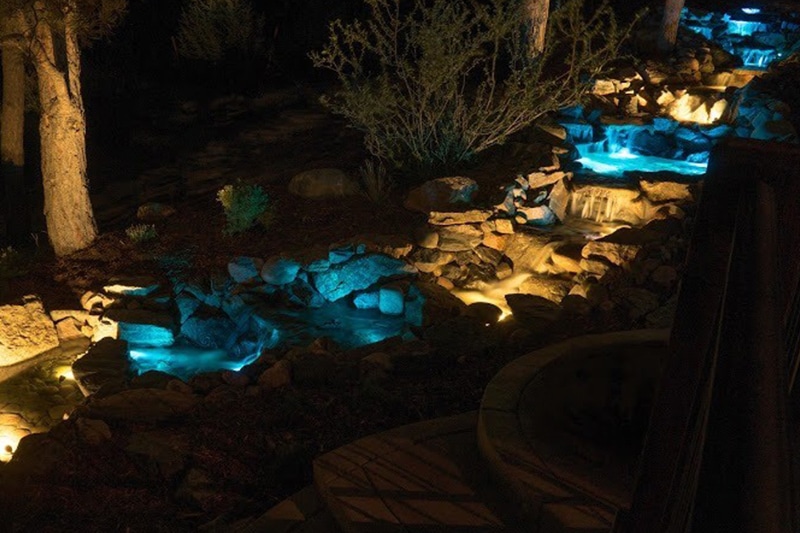
If you’ve lived in metro Denver for any length of time, you know the drill. By late fall, the sun starts setting around 4:30 PM, and suddenly your beautiful backyard feels like it disappears the moment you get home from work. Those gorgeous koi ponds, water features, and landscaping you invested in? They’re sitting in the dark for most of your waking hours at home.
At Art of the Yard, we’ve been helping homeowners across Denver, Littleton, Highlands Ranch, and the surrounding communities create outdoor spaces worth enjoying. And here’s what we’ve learned: a well-designed lighting system can completely transform how you experience your yard during Colorado’s long winter months. Whether you’re concerned about safety, want to show off a water feature, or simply don’t want to feel like you’re walking into a cave every evening, an outdoor lighting refresh might be exactly what you need.
Key Takeaways
- An outdoor lighting refresh helps Denver homeowners safely navigate icy walkways and hidden hazards during winter’s 4:30 PM sunsets.
- Uniform light coverage with warm-toned LEDs (2700K–3000K) provides better visibility than overly bright fixtures that cause temporary blindness.
- LED fixtures rated for cold weather and temperature fluctuations are essential for reliable performance in Colorado’s harsh winters.
- Motion-activated and smart lighting solutions reduce energy costs while providing security exactly when and where you need it.
- Plan outdoor lighting installations before the ground freezes—late summer through early fall is the ideal window for Denver-area projects.
- Thoughtful lighting design transforms water features, pathways, and landscaping into year-round focal points you can enjoy after dark.
Why Denver’s Winter Demands Better Outdoor Lighting
Let’s talk about what makes Denver winters particularly challenging for outdoor visibility. We’re not dealing with the gradual twilight you might find in coastal cities. Here in Colorado, when the sun drops behind the mountains, it goes fast. And with sunset hitting around 4:30 PM during the darkest months, that means most homeowners in Aurora, Westminster, Arvada, and everywhere else in the metro area are coming home to near-total darkness.
This creates a few real problems:
- Safety hazards: Ice, snow, and uneven surfaces become invisible. That decorative stone pathway you love in summer? It’s an ankle-twister waiting to happen in December.
- Security concerns: Dark properties are more attractive targets. Period. Proper lighting acts as a natural deterrent.
- Lost enjoyment: You put time, money, and thought into your outdoor space. It’s frustrating to only see it on weekends or through a window.
Denver’s municipal code actually requires specific lighting standards for commercial properties, mandating LED lights with color temperatures between 2700K and 3000K for proper hazard visibility. While residential properties don’t face the same requirements, those standards exist for good reason. The right color temperature and brightness levels genuinely help you see what you’re doing out there.
For homeowners in Castle Rock, Parker, and the southern suburbs where properties tend to be larger, the lighting challenge can be even more pronounced. More ground to cover means more planning required.
Maximizing Safety and Security During Darker Hours
When we talk to homeowners about outdoor lighting, safety usually tops the list of concerns. And rightfully so.
The key to effective safety lighting isn’t just throwing up the brightest fixtures you can find. In fact, that approach often backfires. Have you ever walked from a brightly lit area into a dark one? Your eyes can’t adjust fast enough, and you end up temporarily blind. Lighting professionals call this “light blindness,” and it’s actually more dangerous than having consistent moderate lighting throughout your property.
Here’s what actually works:
Uniform coverage matters more than intensity. You want enough light to see obstacles and navigate safely, without creating harsh contrasts between lit and unlit areas. A minimum of 0.2 footcandles provides adequate coverage for most pathways and outdoor areas.
Proper shielding prevents glare. Look for fixtures with ratings that direct light downward rather than outward or upward. This keeps the light where you need it (on your walkway) and out of where you don’t (your neighbor’s bedroom window).
Strategic placement around entry points, stairs, and changes in elevation. These are the spots where falls happen most often. In Englewood, Boulder, and throughout the metro area, we see plenty of homes with creative landscaping that includes stone steps, tiered patios, and decorative walkways. Beautiful during the day, but potentially hazardous after dark without proper illumination.
For security purposes, motion-activated lights near doors and driveways still make a lot of sense. They draw attention when someone approaches and save energy when nobody’s around.
Best Outdoor Lighting Options for Colorado Winters
Not all outdoor lighting is created equal, especially when you’re dealing with Colorado’s temperature swings and weather patterns. Here’s what we recommend for homeowners across the metro area.
Pathway and Landscape Lighting
Pathway lights are the workhorses of any outdoor lighting plan. They guide people safely through your yard and highlight the features you’ve worked hard to create.
For Denver winters, fully shielded LED fixtures pointing downward work best. They illuminate the walking surface without creating excessive brightness or light pollution. If you’ve got a koi pond, water feature, or specimen plants, landscape lighting can showcase these even during the darkest months.
The trick is balance. You want enough light to navigate safely and appreciate your landscaping, but not so much that your yard looks like a stadium. Warm-toned LEDs in the 2700K range provide visibility while maintaining a welcoming atmosphere. They’re also easier on the eyes than the harsh white lights you sometimes see.
In neighborhoods like Superior, Louisville, and Wheat Ridge, we often see homes where pathway lighting serves double duty: marking the route to a backyard entertaining area while also highlighting architectural features along the way.
Motion-Activated and Smart Lighting Solutions
Smart lighting has come a long way in the past few years. Motion-activated fixtures remain popular for good reason: they provide light exactly when and where you need it, then turn off to save energy.
But the newer generation of smart outdoor lighting offers even more control. You can schedule lights to turn on at sunset (which changes daily, of course), adjust brightness from your phone, or set different scenes for entertaining versus security. Some systems integrate with home assistants, letting you control everything with voice commands.
For homeowners in Northglenn, Westminster, and other areas where energy costs add up over long winter nights, smart controls can make a real difference in your monthly bills. The lights only run when necessary, and you can dim them when full brightness isn’t needed.
Energy-Efficient Choices for Long Winter Nights
Here’s the reality of Denver winters: your outdoor lights might be running for 14+ hours per day during the darkest weeks of the year. That’s a lot of electricity if you’re using the wrong fixtures.
LED technology has essentially become the standard for outdoor lighting, and for good reason. Compared to older high-pressure sodium or incandescent options, LEDs use a fraction of the energy while producing better quality light. Denver’s municipal guidelines actually require LED bulbs for new commercial installations, phasing out older technologies entirely.
But not all LEDs are equal. For outdoor use in Colorado, look for:
- Cold-weather ratings: Standard bulbs can struggle when temperatures drop. Look for fixtures rated for temperatures well below zero.
- Quality drivers: The electronic components that regulate power to LEDs matter. Cheap fixtures often fail because the drivers can’t handle temperature fluctuations.
- Appropriate brightness: Lumens measure actual light output. For pathway lighting, you typically want fixtures in the 100-200 lumen range. Security lights might go up to 700-1000 lumens.
Solar-powered options have improved dramatically and work well in Colorado’s sunny climate, even during winter. But, they’re generally better suited for accent lighting rather than primary safety illumination. On cloudy days or after heavy snow, they may not provide consistent brightness.
For homeowners in Highlands Ranch, Littleton, and Castle Rock who take pride in their landscaping, the color rendering of modern LEDs is a significant upgrade. They show the true colors of plants, stonework, and water features rather than the orange cast that older lighting technologies produced.
Installation Tips for Denver’s Cold Weather Conditions
Installing outdoor lighting in Colorado presents some unique challenges that you won’t face in warmer climates. Here’s what to keep in mind whether you’re tackling a DIY project or hiring professionals.
Ground conditions matter. If you’re installing fixtures that require footings or posts, timing is everything. Once the ground freezes solid (which can happen as early as November in some years), installation becomes significantly more difficult and expensive. Late summer through early fall is the ideal window for major outdoor lighting projects.
Choose materials wisely. Steel and aluminum fixtures with proper coatings handle freeze-thaw cycles better than cheaper alternatives. Concrete footings provide stability that matters when snow loads accumulate or when spring thaw makes ground conditions unpredictable.
Wiring considerations are particularly important for low-voltage landscape lighting. Buried cable needs proper depth and protection to avoid damage from freeze heaving. Connections should be waterproof and accessible for future maintenance.
Placement with snow in mind. Fixtures that work perfectly in summer can get buried under snowdrifts in winter. Path lights should be tall enough to remain visible after typical snowfalls, and overhead fixtures shouldn’t create icicle hazards near walkways.
At Art of the Yard, we design lighting systems with Colorado’s conditions in mind from the start. We think about how a fixture will perform after a heavy snowfall, not just how it looks in July. For homes throughout Aurora, Boulder, Parker, and the rest of metro Denver, that winter-minded approach makes the difference between a lighting system that serves you year-round and one that becomes a seasonal headache.
For electrical connections beyond low-voltage systems, working with a licensed electrician is worth the investment. Xcel Energy can provide guidance on upgrades to your outdoor electrical service if needed.
Creating Ambiance and Extending Outdoor Living Spaces
Safety and security are important, but let’s be honest: you also want your outdoor space to look good. The right lighting transforms how you experience your yard after dark, turning it from a dark void into an extension of your living space.
Warm-toned lighting in the 2700K range creates an inviting atmosphere that encourages you to actually use your outdoor areas, even when it’s cold. Think about it: with a properly lit patio, fire pit area, or covered outdoor kitchen, there’s no reason you can’t enjoy your backyard on a crisp winter evening.
Water features deserve special attention when it comes to lighting. A koi pond or fountain that goes dark after sunset is a missed opportunity. Underwater lighting, subtle uplighting, or carefully positioned fixtures can turn a water feature into a stunning focal point during evening hours. The interplay of light and moving water creates visual interest you simply can’t achieve any other way.
For homeowners who’ve invested in quality landscaping, lighting helps you appreciate that investment year-round. Specimen trees, architectural plantings, and decorative stonework all benefit from thoughtful illumination. And in Denver’s winter, when deciduous trees are bare and perennial beds are dormant, structural elements and evergreens become even more important to your landscape’s appearance.
Don’t forget about outdoor entertaining. Even in Littleton, Highlands Ranch, and Castle Rock where winter temperatures can drop significantly, Colorado’s dry climate and frequent sunny days make outdoor gatherings possible well into the colder months. String lights over a seating area, well-lit walkways to guide guests, and accent lighting on architectural features all contribute to spaces where people actually want to spend time.
Conclusion
Denver’s short winter days don’t have to mean abandoning your outdoor spaces until spring. With thoughtful lighting design, you can maintain safety, enhance security, and actually enjoy the landscaping and features you’ve worked to create, regardless of what time the sun sets.
The key is approaching outdoor lighting as a system rather than an afterthought. Consider how you use your space, where the potential hazards are, what features you want to highlight, and how everything will perform in Colorado’s challenging weather conditions.
At Art of the Yard, we specialize in creating outdoor spaces that work beautifully in every season. Our team serves homeowners throughout metro Denver, from Arvada and Westminster to Englewood and Castle Rock. Whether you’re looking to add lighting to an existing water feature, refresh aging fixtures, or design a comprehensive lighting plan for a new landscape, we’re here to help.
Ready to transform how you experience your yard this winter? Give us a call or reach out through our website. We’ll walk through your options and help you find the right solution for your property, your style, and your budget. Because your outdoor space should work for you, even when the days are short.
Frequently Asked Questions
Why is outdoor lighting important during Denver’s shorter winter days?
Denver’s winter sunsets around 4:30 PM leave most homeowners arriving home to darkness. Proper outdoor lighting improves safety by illuminating icy paths and uneven surfaces, enhances security by deterring intruders, and lets you enjoy landscaping features like koi ponds and water features year-round.
What is the best color temperature for outdoor lighting in Colorado?
Warm-toned LEDs in the 2700K to 3000K range are ideal for outdoor lighting in Colorado. This color temperature provides adequate visibility for navigating pathways safely while creating a welcoming ambiance. Denver’s municipal code recommends this range for proper hazard visibility.
How do I prevent light blindness with outdoor lighting?
Avoid using overly bright fixtures that create harsh contrasts between lit and dark areas. Instead, focus on uniform coverage with consistent moderate lighting throughout your property. Use fully shielded fixtures that direct light downward, and aim for at least 0.2 footcandles on pathways.
When is the best time to install outdoor lighting in Denver?
Late summer through early fall is the ideal window for outdoor lighting installation in Denver. Once the ground freezes solid—sometimes as early as November—installation becomes significantly more difficult and expensive. Planning ahead ensures your system is ready before the darkest months arrive.
Are solar-powered outdoor lights effective during Colorado winters?
Solar-powered lights have improved and work reasonably well in Colorado’s sunny climate. However, they’re better suited for accent lighting rather than primary safety illumination. On cloudy days or after heavy snowfall, they may not provide consistent brightness for pathways or security purposes.
How can outdoor lighting enhance water features like koi ponds?
Underwater lighting, subtle uplighting, or carefully positioned fixtures can transform a koi pond or fountain into a stunning nighttime focal point. The interplay of light and moving water creates captivating visual interest, allowing you to enjoy your water feature investment during evening hours year-round.